Uncategorized · 27 November 2026
Build a Capsule Wardrobe from Clothes You Already Own
The short answer: Build your capsule wardrobe by selecting clothes you already wear comfortably, then testing them as complete outfits for your actual week. Start with your schedule and laundry routine—not a shopping list or a fixed item count. Add more pieces from your closet whenever the selection cannot cover a real need.
For this exercise, think of a capsule as your working everyday wardrobe, not everything you are allowed to own. Keep occasionwear, specialist clothing and out-of-season pieces separately if that makes getting dressed easier. You do not need to discard useful clothes to make the experiment work.
The method below combines established wardrobe-planning principles—inventory, color coordination and flexibility—with a practical outfit trial. Extension guidance recommends evaluating existing clothes before identifying needs and choosing pieces that coordinate. (extension.usu.edu)
1. Audit your real week before opening the closet
Write down what you expect to do over the next ordinary week. Include work, commuting, errands, time at home and social plans. Note clothing requirements beside each activity.
Make those requirements specific:
- “Office” might mean tailored trousers and closed-toe shoes.
- “Working from home” might require comfortable sitting and a presentable video-call top.
- “Errands” might involve walking, carrying bags or bending.
- “Evening out” might call for a different layer rather than an entirely separate outfit.
Next, note your current weather needs. Plan for the conditions you actually face, including the journey between home and your destination.
Finally, record when clothes become available again after washing. Include drying, ironing and professional-cleaning time—not just the moment the washing machine finishes.
For example, if you prefer a fresh top daily and do not wash during the week, your selection needs enough clean tops to bridge that interval. If you wash midweek, a smaller rotation may work, provided everything dries in time.
Keep underwear, socks, sleepwear, exercise clothing and required uniforms in the practical plan, even if you organize them outside the everyday capsule.
2. Sort by present-day fit, condition and usefulness
Start with the clothes you reach for most often. Then look for overlooked alternatives in drawers, laundry baskets and seasonal storage.
A clothing inventory is an established wardrobe-planning tool; South Dakota State University’s Wardrobes That Work includes inventory and planning worksheets. You can make a simpler version using a notebook or phone. (openprairie.sdstate.edu)
Use four temporary groups:
| Group | What belongs here | Next action |
|---|---|---|
| Ready now | Comfortable, wearable pieces suited to your current week | Try them in outfits |
| Needs attention | Clothes awaiting cleaning, a button, a repair or an alteration assessment | Record the exact task |
| Useful elsewhere | Occasionwear, specialist clothing and out-of-season items | Keep outside the daily selection |
| Undecided | Pieces you avoid or cannot currently style | Set aside for a separate review |
Try on uncertain items with the undergarments and shoes you would normally wear. Sit down, raise your arms, bend and walk. Notice whether you keep adjusting the waistband, neckline or sleeves.
Inspect fastenings, seams, hems and high-friction areas. A garment awaiting repair is not yet an available outfit component.
Avoid making irreversible decisions during this first pass. An item that does not belong in this week’s capsule may still have a useful place in your wardrobe. Equally, an expensive purchase does not have to earn a place if you dislike wearing it.
3. Let care requirements shape the rotation
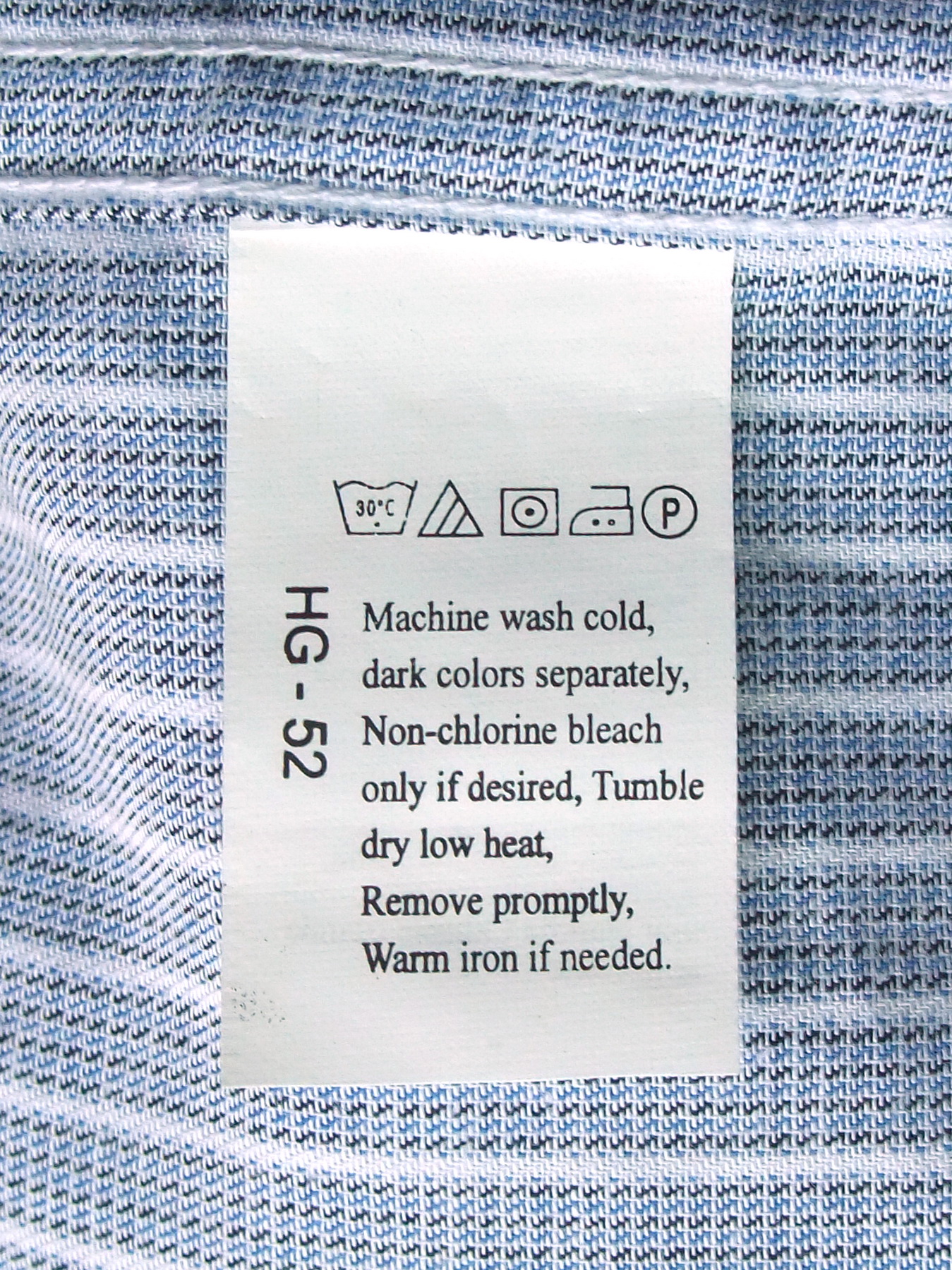
Read the care labels on your shortlisted pieces. Do not assume that garments with similar fiber content can all go into the same wash. FTC guidance explains that care instructions must account for the whole garment, including components such as linings and trim. (ftc.gov)
Beside each item, record its practical constraint:
- Machine wash and the specified drying method.
- Hand wash.
- Dry flat.
- Ironing needed before you would wear it.
- Professional cleaning.
- Unclear or missing instructions.
Follow the garment’s warnings. The FTC distinguishes “Dryclean only” from a simple “Dryclean” instruction: “only” indicates that washing is not safe. An instruction giving one cleaning method does not automatically establish another safe method. If instructions are missing or unclear, ask the manufacturer or a professional cleaner before experimenting. (ftc.gov)
Wool needs its own rotation check. Woolmark recommends resting wool garments for 24 hours between wears and drying wool sweaters flat unless their care label permits tumble drying. It also recommends folding knitted wool garments rather than hanging them for storage. (woolmark.com)
The planning consequence is straightforward: do not make tomorrow’s outfit depend on a garment that may still be drying, resting or at the cleaner. Keep an alternative from your existing wardrobe available.
4. Find a color palette in what you already wear
Lay out your ready-now clothes where you can see them together. Look for repeated colors in your favorite outfits rather than choosing an entirely new palette.
Extension wardrobe guidance recommends a basic color plan and coordinating pieces. Use that as a starting point, not a requirement to dress entirely in neutrals. (extension.usu.edu)
Try this approach:
- Choose your starting bottoms. Pick the trousers, jeans or skirts you wear comfortably.
- Place possible tops beside each one. Keep combinations you genuinely like.
- Add layers and footwear. Check the complete outfit rather than the colors alone.
- Keep room for personality. A printed shirt or bright cardigan can belong if you enjoy wearing it with the other pieces.
For an illustrative palette, navy trousers and dark jeans might work with cream, blue stripes and burgundy. But your existing black, green and pink clothes are a better starting point if those are what you love.
Not every garment must match every other garment. Instead, look for useful connections. Ask whether a top has another wearable pairing if its usual bottom is unavailable.
Do not buy matching accessories to rescue a palette that only exists on paper. Test the combinations with what you own first.
5. Turn individual pieces into repeatable outfit formulas
Now get dressed. Clothes arranged on a bed are candidates; clothes tried together are actual outfits.
Use a few formulas to guide the session:
- Relaxed: comfortable bottom + simple top + easy layer.
- Polished everyday: trousers or skirt + shirt or knit + structured layer.
- Dressier variation: a tested base outfit + a different existing layer, shoes or accessory.
These are prompts, not universal style rules. Swap garments according to your preferences, mobility needs and dress code.
For each outfit, check:
- Can the top sit comfortably tucked or untucked?
- Does the layer close without restricting movement?
- Do sleeves fit comfortably inside the jacket or cardigan?
- Does the hem work with the shoes you intend to wear?
- Are you comfortable sitting and walking?
- Would you actually choose this outfit tomorrow?
Photograph successful combinations, including shoes and outerwear. Save them in a phone album so you can repeat them without rebuilding the outfit from memory.
If something feels wrong, record the specific issue. “I need new clothes” is difficult to act on. “This shirt bunches beneath this cardigan” gives you a combination to change.
6. Test a sample week with two bottoms
The following is an illustrative outfit plan, not a recommended shopping list or a claim that this quantity suits everyone.
Suppose your existing clothes include:
- Navy trousers and dark jeans.
- A cream T-shirt, striped top, blue shirt, burgundy knit and plain long-sleeved top.
- A cardigan and an unstructured jacket.
- Comfortable sneakers and loafers.
Assume the garments suit the weather, the workplace permits these combinations, and you can wash suitable items midweek.
| Day | Base outfit | Layer and shoes |
|---|---|---|
| Monday | Navy trousers + blue shirt | Jacket + loafers |
| Tuesday | Dark jeans + cream T-shirt | Cardigan + sneakers |
| Wednesday | Navy trousers + striped top | Jacket + loafers |
| Thursday | Dark jeans + burgundy knit | Sneakers; suitable outerwear as needed |
| Friday | Navy trousers + plain long-sleeved top | Cardigan + loafers |
| Saturday | Dark jeans + clean cream T-shirt | Jacket + sneakers |
| Sunday | Navy trousers + clean blue shirt | Cardigan + sneakers |
This plan repeats clothes deliberately. It assumes the cream T-shirt and blue shirt have been cleaned and fully dried before their second appearance. Rewear bottoms and layers only when their condition and your circumstances make that appropriate; substitute another owned item whenever cleaning is needed.
If the burgundy knit is wool, account for Woolmark’s resting guidance before scheduling another wear. Do not interpret a planned repeat as a reason to delay necessary cleaning. (woolmark.com)
Adapt the example rather than forcing your life into it:
- More formal workplace: Replace jeans with another suitable bottom you own and test the outfits against your employer’s requirements.
- Casual or active days: Prioritize movement, practical pockets and suitable footwear.
- Hot conditions: Use appropriate lighter pieces and allow more clean tops if needed.
- Cold conditions: Test the outfits with your actual coat and any additional layers.
- No midweek laundry: Add enough existing clean tops to remove the planned repeats.
- A preference for dresses: Use a dress in place of a top-and-bottom combination.
Two bottoms are simply the worked example. Expand the rotation if laundry, wear, weather or comfort requires it.
7. Identify genuine gaps after the trial—not before
Wear your selected outfits through a normal week and keep a short log. Record what you wore, what you changed and why.
At the end, separate problems into three categories:
- Combination problem: The garments work individually but not together.
- Availability problem: A useful piece is repeatedly awaiting cleaning or repair.
- Coverage problem: You lack suitable clothing for a recurring activity.
Try a no-purchase response first. Substitute another owned garment, repeat a successful outfit, complete a manageable repair or move a useful piece back into rotation.
If a gap remains, describe its function rather than naming an aspirational product. “A comfortable, washable top that works with both office bottoms” is more useful than “a perfect capsule blouse.”
Watch for common mistakes: excluding useful duplicates, removing every distinctive piece, counting imaginary combinations and treating a small item total as the goal. A capsule should serve your week, not create extra laundry or discomfort.
Before buying anything, check:
- I have included clothes currently in the wash or awaiting repair.
- My selection covers my actual activities and weather.
- I have tried complete outfits with shoes and layers.
- My care and laundry schedule makes planned repeats possible.
- I have an alternative when a key piece is unavailable.
- I have tested another garment I already own.
- Any remaining gap has a clear, recurring purpose.
Keep the combinations that worked and revise the ones that did not. The aim is a dependable set of clothes you enjoy wearing—not the smallest possible wardrobe.